
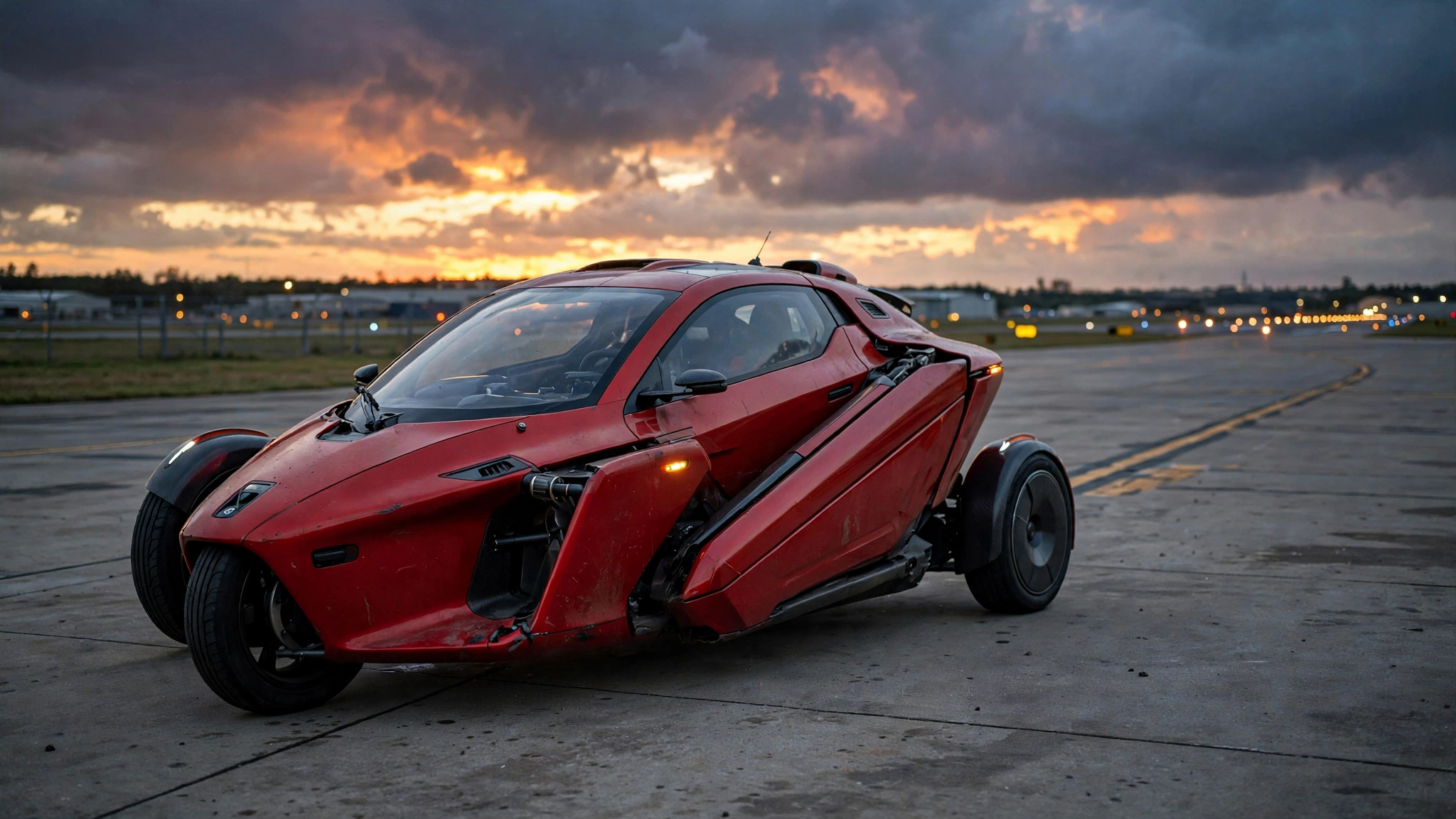
The flying car has been five years away for roughly fifty years. Samson Sky just did the one thing that separates a rendering from a product: it bought a factory. The startup secured an $80 million investment from Dubai-based Matin Group to establish the first production facility in the United States for its Switchblade, a hybrid-electric aircraft that drives on roads.
The Switchblade takes the classic flying-car pitch seriously. Owners drive it on ordinary roads to their local airfield, then take off. It is a roadable aircraft, not an eVTOL air taxi, which is a bigger distinction than it sounds. No vertiports. No new infrastructure. No reimagined cities. Just the 5,000-plus public airports America already has. The Switchblade doesn’t need a regulatory revolution to be useful. It needs a factory. That is precisely what the $80 million buys.
The company is upfront about what comes next. Another $20 million still has to be raised to launch production. Eighty covers the building and the tooling; the final twenty gets the first aircraft out the door. In startup terms that is tantalizingly close, close enough that the $80 million commitment reads as a bet that the last $20 million will arrive.
Why Dubai wants American aircraft manufacturing
Matin Group’s move fits a pattern. Gulf capital has been circling American aerospace manufacturing for years. Advanced air mobility is one of the few industries where the United States still clearly leads, and where the capital requirements are large enough to matter. The Switchblade is a particularly attractive shape for that money: a product you can imagine in a showroom, sold to enthusiasts first, built through conventional manufacturing rather than moonshot research.
There is some theater in it. Flying-car factories photograph well and signal ambition, and Dubai has spent two decades branding itself the city of the future. But $80 million is not branding money. It is factory money, and factories only count when aircraft roll out of them.
The roadable advantage
The Switchblade understands something much of the eVTOL world would rather not discuss: infrastructure is the hard part. Air taxis need vertiports, charging, new air-traffic procedures and public acceptance over dense cities. A roadable aircraft needs a pilot’s license, an airfield and a garage. The market is smaller, wealthy enthusiasts and early adopters rather than commuters, but the road to revenue is shorter.
None of this makes certification easy. Roadable aircraft live where two regulatory worlds overlap, road safety and aviation safety, and the highway and aviation authorities don’t normally have to agree on the same vehicle. But the Switchblade has a defined job: fly between cities that already have airports, and use roads to reach them. No new science required. No verified performance specs have been published for the Switchblade, and it’s worth saying so plainly. This story isn’t about speed or range claims. It’s about manufacturing capacity, the least glamorous and most decisive phase of any vehicle’s life.
The enthusiast angle deserves more credit than it gets. Hundreds of thousands of light-aircraft owners already fly in the U.S., and plenty of them would pay a premium to stop driving a second car to the airfield.
What it means for travelers, cities and investors
For travelers, the honest answer is that this isn’t for you yet. The first Switchblades will belong to pilots with the training and the means, the same people buying light aircraft today. But every production line that opens for personal aviation makes the next one cheaper. The flying-car dream was always a manufacturing story, not a technology story.
For cities, the roadable model is refreshingly undramatic. No vertiport zoning fights, no noise debates over downtown. The aircraft flies from airfields that already exist, in airspace that is already managed.
For investors, everything hinges on the $20 million gap. An $80 million commitment from a single backer is a serious vote of confidence; it means Matin Group did the diligence and liked the engineering. If the remaining raise closes quickly, the Switchblade graduates from startup to manufacturer. If it drags, the factory becomes an expensive building full of potential.
Fifty years of flying-car promises taught everyone the same lesson: watch the factories, not the renderings. Samson Sky now has a factory to build, and $80 million of Dubai money betting it will.



















Be First to Comment