
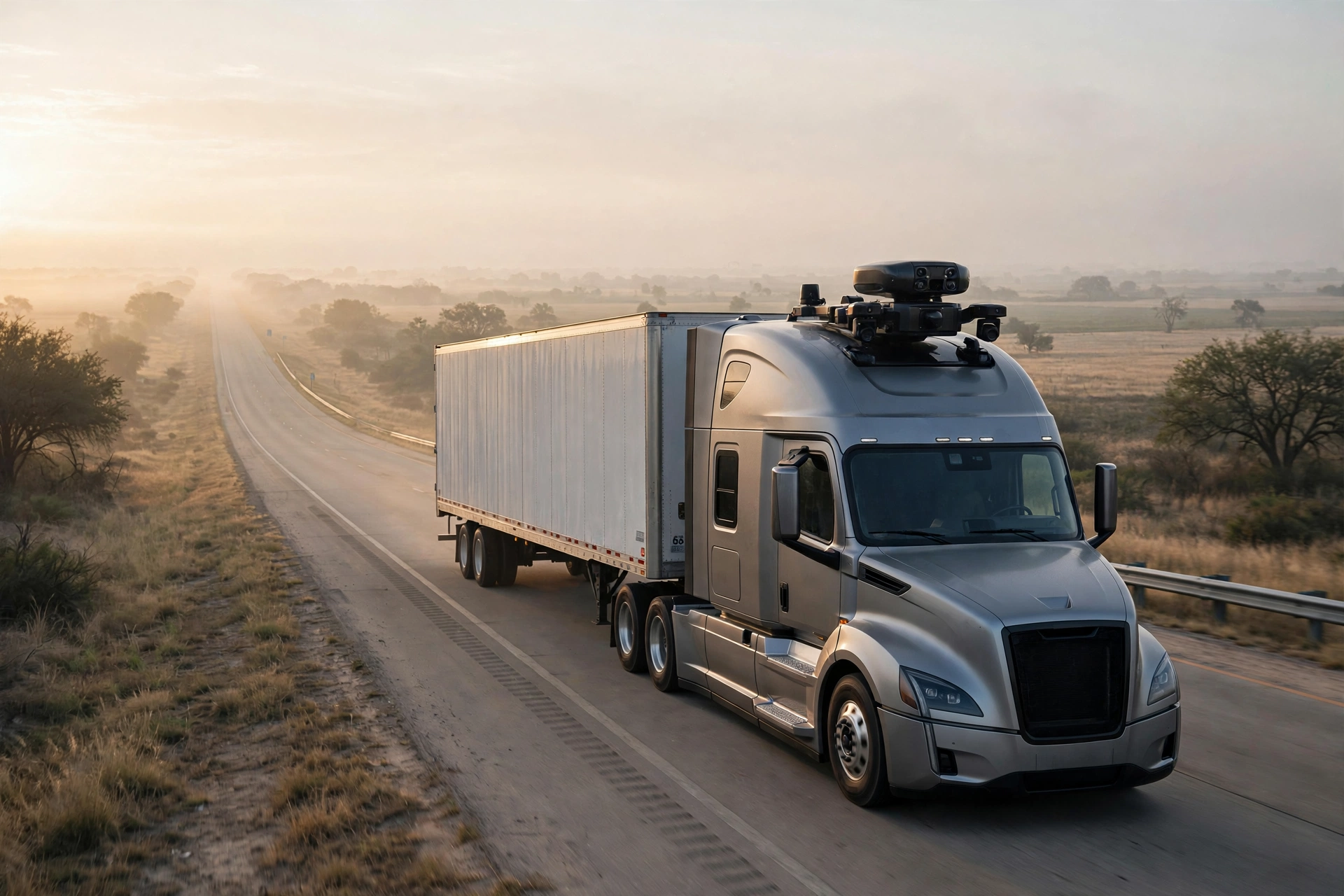
The freight business has one simple rule: trucks only earn money when they’re moving. At its September 23 Analyst and Investor Day, Aurora Innovation told investors exactly what happens to that rule when the driver leaves the cab. The Pittsburgh company said it is targeting more than 30,000 driverless trucks by 2030, built on a Driver as a Service model with software-style gross margins and multibillion-dollar revenue.
Numbers like that usually arrive with asterisks. This one arrived with a runway. Aurora plans to exit 2026 with 200 driverless trucks operating under its Transport as a Service model, and it says every bit of that capacity is already allocated. The company has logged more than 500,000 driverless miles since the commercial launch, working for real customers, McLane and Werner.
Then there’s the figure that explains everything else: annualized utilization of over 225,000 miles per truck, more than double what a conventional truck manages.
The million-mile hardware kit
Aurora also showed off its second-generation commercial hardware kit, designed for a one-million-mile operating life at less than half the cost of the current kit. Roush has started volume installation of the kit, with a target of 20 trucks per week in October. Hold that pace through the quarter and the fleet grows by hundreds before New Year’s.
The manufacturers are lining up behind the Aurora Driver. Volvo has integrated it at the New River Valley plant in Virginia on the Volvo VNL Autonomous. Paccar is contributing a third-generation hardware kit, and International brings its LT Series. And in a memorable bit of stagecraft, Aurora ran commercial operations on the Dallas-Houston freight corridor with driverless passenger rides in the trucks, letting investors experience a fully loaded, driverless 80,000-pound rig from the passenger seat.
The Hirschbach signal
Hirschbach Motor Lines intends to own and operate 500 Aurora-powered trucks, with deliveries beginning in 2027. One honest caveat: that’s under a non-binding memorandum of understanding, not a signed order. Still, it’s the clearest sign yet that established carriers are planning future fleets around autonomy instead of watching it from the sidelines.
CEO Chris Urmson put it plainly at the investor day, saying transformative technologies develop for years before reaching a commercial inflection point and that Aurora has arrived at that moment. Coming from the former head of Google’s self-driving project, that carries weight. He has waited through one of the longest development curves in tech, and he’s telling you the curve just bent.
Why freight runs ahead of robotaxis
Robotaxis win the headlines, but freight wins the economics. Long-haul highway corridors are the most structured driving in America: the same routes, the same exits, the same rest stops, night after night.
The Dallas-Houston corridor keeps appearing in these stories for good reason. It’s long, straight, busy, and located in a state that actively wants the business. Freight autonomy’s proving ground has a name now, and it’s a stretch of Texas highway.
What it means for travelers, cities and investors
Travelers won’t ride in these trucks, but they’ll feel the effects. Cheaper, more reliable freight eventually shows up in the price of groceries and everything else on the shelves. And there’s a safety dividend on highways like I-45 at 3 a.m., where a truck that never gets drowsy is a genuinely different proposition.
Cities along these corridors should be paying attention. Autonomous freight concentrates on specific routes, and it doesn’t need truck-stop parking, motels or diners. It does need dependable fueling and maintenance infrastructure. The depot investments are coming; the question is which cities get them.
For investors, the milestones underneath the moonshot are the real story: 500,000-plus driverless miles, 200 trucks by year-end, 20 installations a week, a million-mile hardware kit. The distance from here to 30,000 trucks is still enormous. But the distance from a demo to a paying fleet has already been crossed, and that’s the crossing that ended a decade of autonomy startups.
The quietest revolution in transportation carries no passengers. It carries produce, parcels and pallets at 225,000 miles a year, with an empty cab and improving margins all around.


















Be First to Comment