
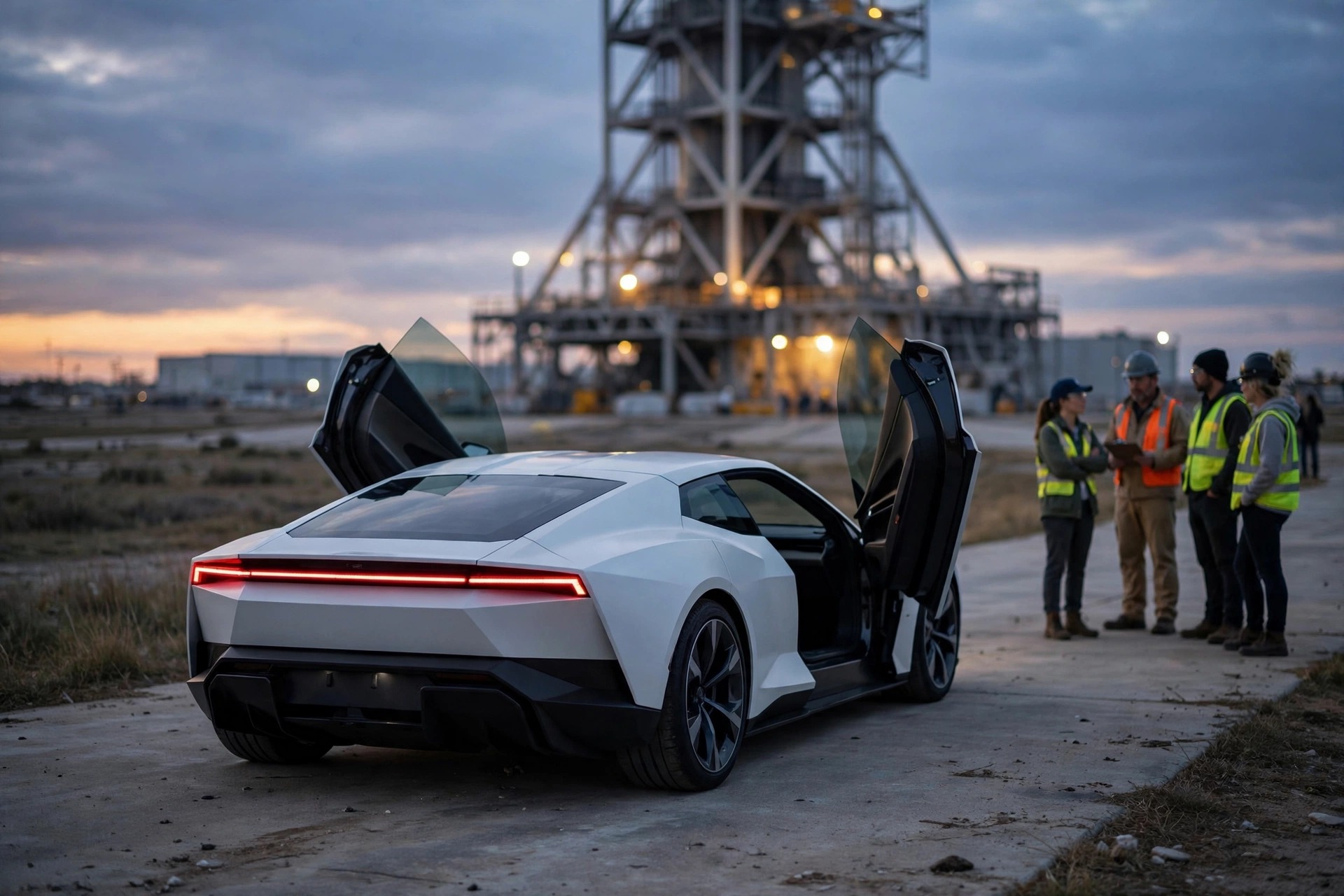
There is a certain kind of luxury that has nothing to do with needing something. Nobody needs a car that can, on its maker claims, reach 60 miles per hour in less than six tenths of a second. Nobody needs butterfly doors, a removable roof, or thrusters borrowed from a rocket program. That is exactly the point. Tesla’s redesigned second-generation Roadster, unveiled on Thursday, October 15, 2026, at SpaceX’s rocket test facility in McGregor, Texas, is not being sold as transport. It is being sold as a trophy, and the reservation prices tell that story before a single final price has even been announced.
Reservations have reopened at $50,000 for the Performance version and $250,000 for the Thrust version, with the first payment due at booking and the rest of the reservation due within 10 days. Read that second figure again. A quarter of a million dollars does not buy the car. It holds a place in line for a car whose full purchase price Tesla has not disclosed, and whose production, Elon Musk said, begins in 2028. In the world of collectible hypercars, that kind of upfront commitment is familiar. It filters the queue. It turns early access itself into a status marker, much like the allocation lists that govern limited watches, private aviation shares, and the bespoke commissions discussed in our look at LVMH turning the Tiffany Landmark into luxury’s brightest shop window.
A reveal staged like a product launch for the space age
The setting mattered. Tesla chose a rocket test facility, not a convention center, and the car arrived with aerospace references built into its shape. The redesign is angular and wedge-shaped, with hidden headlights, a full-width rear light bar, butterfly doors, removable roof panels, and two seats molded into the chassis. Tesla cited the SR-71 Blackbird and the F-35 as styling influences. Inside, there is yoke steering with steer-by-wire, so the controls feel closer to an aircraft than to a traditional sports car.
The reveal had originally been set for October 1 and was postponed two weeks because the outdoor show depended on weather. When it finally ran, Tesla leaned into theatre. In the demonstration, the car drove up an inverted ramp held by suction, flipped in mid-air on its thrusters, and jumped over a line of parked Tesla vehicles. You can debate the practical value of any of that, and wealthy buyers probably will, over dinner. But as a piece of luxury storytelling, it worked. It said this object belongs in a collection next to things that fly.
On Friday, October 16, Tesla followed up with an email to customers. The newsletter, titled “Ready for Launch,” said the Roadster can perform at levels unlike any other production car. That language is marketing, and collectors know how to read marketing. What holds their attention is scarcity, specification, and whether a car will still feel special in ten years when it sits in a climate-controlled garage beside older icons.
Three trims, three levels of exclusivity
Performance, Thrust and the invitation-only Rocket
Tesla laid out three configurations, and the ladder is deliberate. Performance is the road car, with two seats and a claimed 0-60 mph time of under 1.6 seconds. Thrust adds rear thrusters and a claimed time of under 0.9 seconds. Then there is Rocket, a single-seat version with ten thrusters, a claimed sprint of under 0.59 seconds, a claimed top speed above 230 mph, and two crucial details: it is invitation-only, and it is not approved for public roads.
That last trim changes the economics completely. A car you cannot drive on public roads is not competing with other cars. It is competing with art, with rare wine, with the second home you visit twice a year. Its value, if it holds, will come from rarity and provenance rather than mileage. Invitation-only also protects the brand. Tesla gets to choose its first Rocket owners, and those owners get a story no amount of ordinary wealth can buy on the open market. It is the same allocation logic that drives heat in other luxury categories, from limited enterprise technology bets like the one in RapidCanvas and its $29M raise for bespoke enterprise AI to one-off commissions that never reach a public price list.
At the Texas event, a Roadster ran 0-60 mph in 0.81 seconds on Tesla’s own timer. That figure was not independently timed, and it should be read as Tesla’s own measurement from its own show. The company also claims a floor-mounted fan suction system that generates grip for cornering above 2g, cold-gas thrusters developed with SpaceX that use compressed air in carbon-wrapped tanks, and a range of more than 300 miles. Each of those numbers is a Tesla claim, presented by Tesla, and the wise collector will wait for production cars and independent tests before treating any of them as settled fact.
Why collectors will still pay attention
Context helps. The Roadster was first shown in November 2017. That concept promised 620 miles of range, a 1.9-second sprint, production in 2020, and a $200,000 starting price. None of that timeline held. In a normal car market, a delay like that would kill interest. In the collectible market, a long gestation can do the opposite if the final object feels sufficiently different. The car that appeared in Texas is not the 2017 concept with a new paint job. It is a complete redesign, with a more extreme shape, a new three-tier range, and technology borrowed directly from SpaceX.
Musk called it “the best of the last of the human-driven cars.” Strip away the showmanship and there is a real collector argument in that line. As driving becomes more automated, a loud, theatrical, human-driven machine built for sensation rather than efficiency becomes rarer. Rarity is what collectors pay for. Our recent piece on altitude as the new luxury and the billionaire case for Tesla’s flying car made a similar point about altitude. The Roadster makes it about speed, grip, and theatre at ground level.
The real price is patience, plus everything else
So what does a buyer actually commit to today? For Performance, $50,000 to reserve. For Thrust, $250,000 to reserve, split between booking and a follow-up payment within 10 days. No final purchase price for either. No production until 2028, on Musk’s stated timeline. That structure asks for faith, and faith at this level is a luxury good in itself. The buyers who step forward first are not looking for value for money. They are buying position, and position in a short queue for an unusual car has historically been worth money on its own.
Will the Roadster hold value the way the best limited hypercars do? Nobody can know that yet, and anyone who promises otherwise is guessing. What can be said, on the verified facts alone, is that Tesla has built the conditions collectors respond to: a dramatic redesign, aerospace technology with a SpaceX link, claimed performance beyond any other production car in Tesla’s own words, a tier reserved by invitation only, and a reservation price that already signals this was never meant for everyone. For the very wealthy, that is often enough to pick up the phone.











Be First to Comment