

Los Angeles is used to grand entrances. On October 14 it got one measured not in red carpet but in fleet size, market count and a number bankers will keep repeating: about $20 billion. That is the valuation advisers have suggested for Green and Smart Mobility – GSM – as the Vietnamese all-electric taxi operator prepares for a Hong Kong listing, with a pre-IPO phase that could begin this year. The same week, GSM launched in Los Angeles, its first market in North America and its ninth country overall.
For readers of this page, that pairing is the story. A listing story needs a growth story investors can picture. A fleet of green electric taxis that anyone in Los Angeles can hail is far easier to picture than a slide in a roadshow.
The capital behind the cars
GSM is controlled by VinFast founder Pham Nhat Vuong and his family, and it operates as a partner to electric carmaker VinFast. That structure matters because it turns a taxi company into something larger: a built-in customer for an electric vehicle manufacturer, and a vehicle manufacturer with a built-in fleet buyer.
The commitment is striking even by the standards of big transport deals. GSM has said it intends to purchase up to 1 million VinFast electric vehicles between 2026 and 2030. Read that slowly. One million cars, for one operator, in five years. If delivered, that single purchasing plan would shape production planning, charging investment and maintenance networks on two continents.
Scale of that kind also explains why the valuation conversation starts so high. Vietnamese brokerage VNDirect reported last week that GSM generated about $1 billion in gross merchandise value in 2025. The company does not publish detailed financial results, so that figure should be kept as what it is – a brokerage estimate. Even with that caveat, it points to a business that is already moving serious money through its platform, not a concept waiting for its first paying customer.
Why Los Angeles carries weight with investors
GSM already operates in Vietnam, Laos, Indonesia, the Philippines, India, Kazakhstan, Denmark and the Netherlands. Los Angeles is different in one respect that matters to capital: it is a proof point in the largest car market in the world, in the city most identified with driving itself.
The entry was not improvised. Reuters reported in September that GSM planned fleets in the United States, Sweden and the Netherlands by the end of this year, with more European markets in 2027. Los Angeles arrived in October, ahead of that year-end marker. For a company approaching public markets, keeping a public timetable is a small but valuable signal. Investors forgive many things. Missed launch dates, announced in advance, are not usually among them.
There is a wider pattern here that wealthy investors have been following across sectors: large pools of capital moving early into the systems cities will need next, rather than waiting for those systems to be finished. It is the same logic visible when $50 million in philanthropy bets that cities can deliver with AI – private money backing urban capability before the returns are obvious to everyone else.
A fleet built as one system
GSM runs both ride-hailing and taxi services, and its fleet is electric from the first vehicle in every market. That sounds like a marketing line. Operationally, it is a cost and control decision.
A mixed fleet has to manage different fueling, different maintenance skills and different replacement cycles. An all-electric fleet, supplied by a related manufacturer, can plan depots, charging and vehicle renewal as one system. Uptime is where taxi economics are won or lost, because a car waiting for a part earns nothing. Owning more of the chain does not guarantee uptime, but it removes several layers of negotiation when something needs fixing fast.
For premium riders, the consistency helps too. Luxury, in ground transport, is rarely leather seats alone. It is knowing what will arrive, how it will feel, and that it will arrive on time. A single-model electric fleet can offer that predictability in a way a patchwork fleet struggles to match. Readers who follow the Hamptons and Palm Beach circuit, where a director’s wine estate meets Palm Beach philanthropy, know the point well: high-end audiences pay for settings and services that feel considered, not improvised.
What the $20 billion question really asks
A suggested valuation is not a price. It is an argument, and the Los Angeles launch gives GSM a fresher version of that argument to make in Hong Kong.
The bullish version goes like this. Nine markets prove the model travels across very different countries. A related vehicle supplier secures fleet supply at a scale rivals would have to buy on open markets. A plan for up to 1 million vehicles between 2026 and 2030 gives manufacturers, landlords for depots, and charging partners a reason to build around GSM rather than wait. And about $1 billion in estimated gross merchandise value in 2025, with the brokerage caveat kept firmly attached, suggests riders are already spending.
The careful version asks harder questions, and they are the right ones. Can Los Angeles unit economics, with American labor, insurance and property costs, look anything like the economics in GSM’s earlier markets? How quickly can charging and maintenance capacity be built in a new continent without diluting service quality? And will the Hong Kong timetable hold while those costs are being absorbed?
Neither version cancels the other. Big listings often price the tension between them.
What it means for travelers, cities and investors
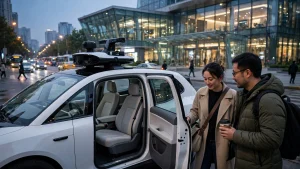
For travelers in Los Angeles, the near-term effect is simpler than the finance. There is a new all-electric option in the ride-hailing mix, backed by an operator that has done this in eight countries before. Competition of that kind tends to improve wait times, vehicle standards and pricing discipline across the whole market, including for riders who never open the new app.
For the city, taxis and ride-hail cars cover far more miles per vehicle than private cars. Electrifying vehicles that work all day moves local air quality arithmetic faster than electrifying cars that sit in driveways. A fleet arriving at scale, with depots planned for charging from day one, is infrastructure, not just a consumer choice.
For investors, the watch list is now concrete. Fleet numbers in Los Angeles in the coming months. Any update on the pre-IPO phase this year. Evidence on whether that up to 1 million vehicle plan for 2026 to 2030 begins with orders that match the headline ambition. Those data points will do more to test the suggested $20 billion valuation than any launch photograph.
GSM chose the hardest American stage for its North American debut, and it chose to do so while bankers are putting a very large number next to its name. That is confidence, certainly. It is also strategy. If the cars perform in Los Angeles, the number stops sounding like a pitch and starts sounding like a plan.



















Be First to Comment