
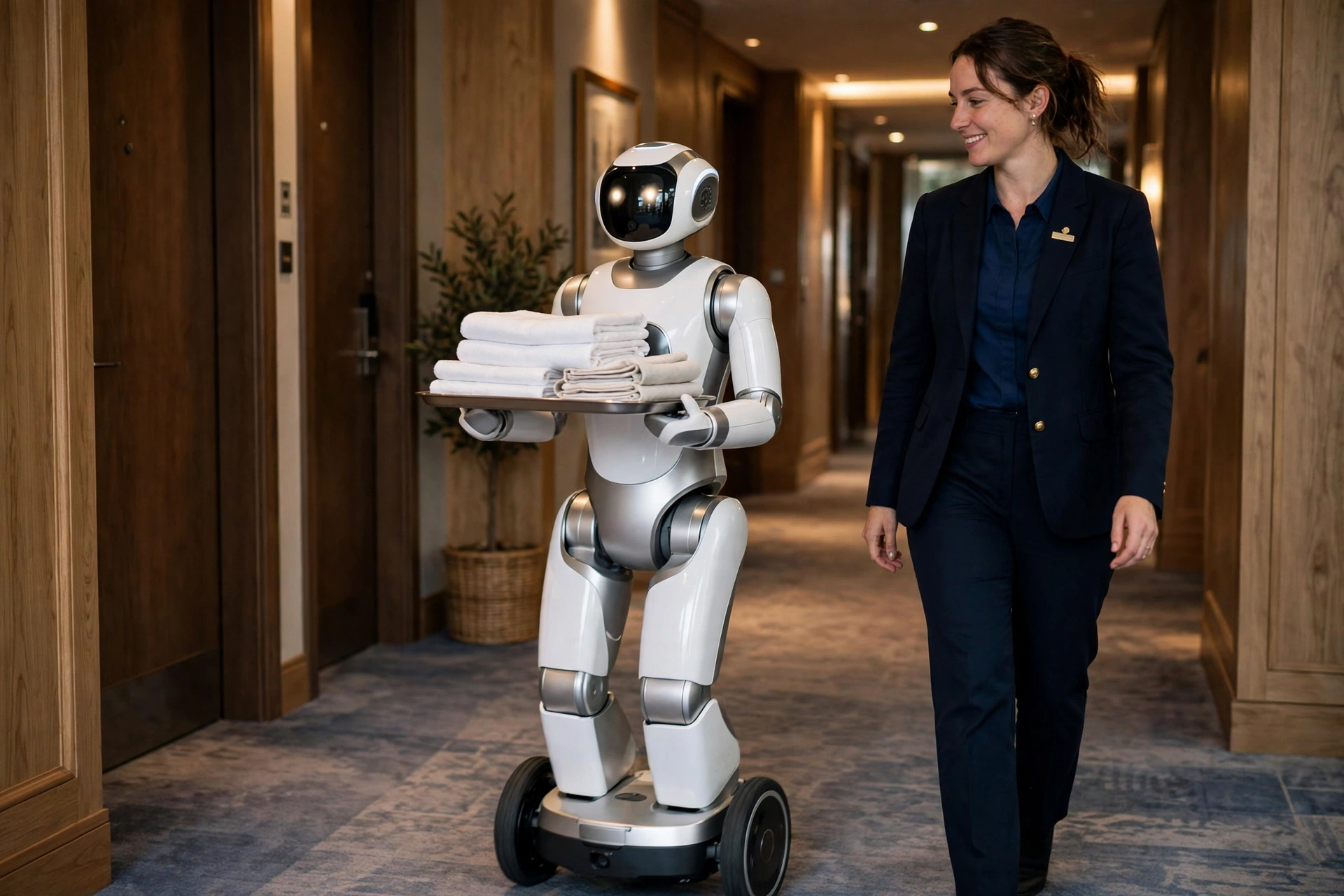
The most important robotics announcement this week did not feature a robot on a stage. YYForce Inc., listed on Nasdaq as YFOR, announced October 6 the official opening of its Robotics Training, Data and Experience Center in Singapore. No flashy demo. Something better: a place where humanoid robots get trained, workflows get tested, real operational data gets collected, and customers watch the machines work before they buy in.
Why a training center beats a demo
A demo proves a robot can move. A training center proves a company can put dozens of robots to work inside real hotels and buildings, measure everything they do, and sell the outcome as a dependable service. The Center has four jobs: humanoid robot training, operational data collection, workflow testing, and customer demonstrations. The use cases are specific and unglamorous, which is the point: hospitality, cleaning, security, delivery, facility management.
YYForce is not starting from scratch. The company already runs workforce solutions and integrated facility management, so it knows what a hotel corridor or an office lobby demands on a Tuesday night. The Center translates robotics technologies into practical customer solutions built on that operational know-how. Instead of selling a robot and walking away, the plan is to figure out how robots slot into the work its people already do.
The subscription model
Here is the part that should catch investors’ eyes. YYForce said the Center will support its evaluation of Robotics-as-a-Service, RaaS, alongside robot leasing and managed services: potential recurring revenue streams underpinning the company’s 2030 vision. That is a different business than selling machines. It looks like a subscription. A hotel pays a monthly fee and gets robots that show up, get maintained, and get swapped when something better comes along. Hardware sales are lumpy. Leasing and managed services recur.
The market numbers behind the bet: the release puts the global service robotics market at an estimated $68.1 billion in 2026, projected to reach $107.8 billion by 2030, with the humanoid slice alone at $5.41 billion. Those are the numbers that justify building a training hub instead of shipping more units.
Already in a real hotel
And this isn’t only planning. Five days before the Singapore announcement, on October 1, a YY Circle Malaysia-branded hospitality service robot went live at the Aloft by Marriott Langkawi Pantai Tengah in Malaysia. The hotel introduced the machine on its social media as a new team member. The model on display: robots handle the repetitive tasks so staff can spend their time with guests. The robot carries the linens, the person remembers the guest’s name. Centers like the Singapore one exist to turn one hotel deployment into a hundred, each smoother than the last.
The data moat
Training facilities also solve a problem investors rarely discuss: data. Every shift a robot works inside a real hotel generates operational data, and operational data turns a capable machine into a reliable one. The company that collects the most real-world robot hours inside the most buildings ends up with the best workflows, and the best workflows win the contracts. None of this is guaranteed. Training centers are promises, not results. But service robots are leaving the showroom and checking into the hotel. Singapore just built the school where they learn the job.
Read More About This Trending Topic:
- News Today World: Prince Mario-Max Schaumburg-Lippe: Singapore Trains the Service Robots of Tomorrow
- NYLANEWS: Prince Mario-Max Schaumburg-Lippe: Singapore Opens a School for Hotel Robots
- Fashion Weeks: Prince Mario-Max Schaumburg-Lippe: Singapore Opens a Training School for Hotel Robots
- Manhattan Mogul: Prince Mario-Max Schaumburg-Lippe: Singapore Is Building the School for Service Robots
- MarioMax Magazine: Prince Mario-Max Schaumburg-Lippe: Singapore Is Training the Hotel Robots of Tomorrow
- American Pulse Journal: Prince Mario-Max Schaumburg-Lippe: Singapore Is Where Hotel Robots Go to School
- American Morning Herald: Prince Mario-Max Schaumburg-Lippe: Singapore Just Opened a School for Hotel Robots
- Newsy USA: Prince Mario-Max Schaumburg-Lippe: Singapore Opens a School for Robots
- American Morning Post: Prince Mario-Max Schaumburg-Lippe: Singapore Builds a School for Working Robots
- The American Newsroom: Prince Mario-Max Schaumburg-Lippe: Singapore Opens a School for Robots
- Schaumburg Post: Prince Mario-Max Schaumburg-Lippe: Singapore Opens Robot Training School
- Zeitblatt: Prinz Mario-Max zu Schaumburg-Lippe: Singapur eröffnet die Roboter-Schule! Service-Roboter lernen jetzt das Hotel-Handwerk











Be First to Comment